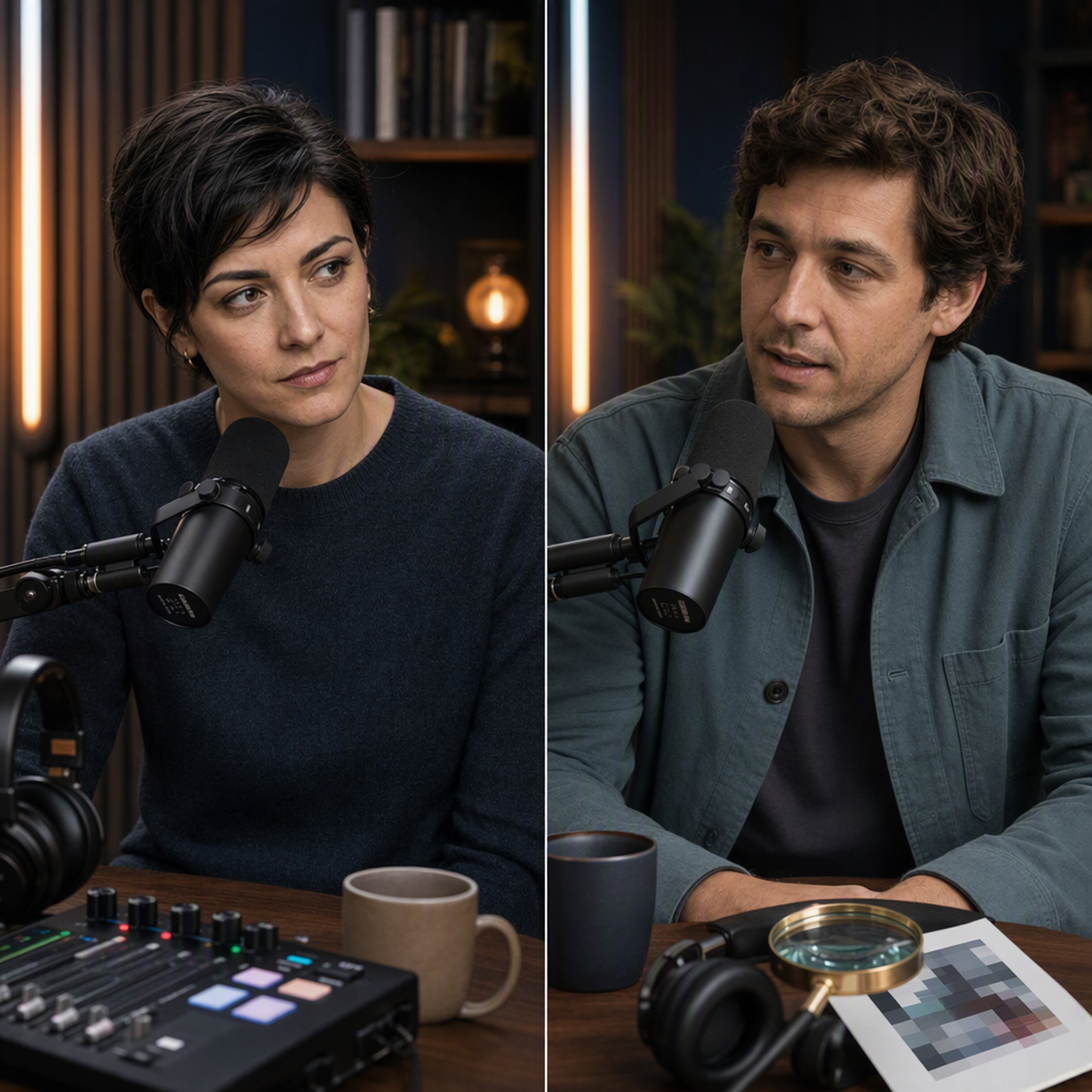
Episode notes
Microsoft Paint can generate an image on your PC, but it first asks a Microsoft server for a unique ID and hides that ID in the pixels. Alex and Jordan examine why the local model still has a remote gate. They also look at EU packaging rules that can cost a tiny hardware seller about €1,150 a year to reach four countries, Apple's reversal on the Hide My Email domain, and Thomson Reuters spending $40 million to train a legal model on top of Qwen. The side of tech news nobody talks about.
Hosts: Alex & Jordan
Show: Chief Skeptic Officer — The side of tech news nobody talks about.
Drop: Daily at 7:00 A.M. America/New_York
Episode date: 2026-08-25
In this episode
Paint asks permission before it draws — A local image model still sends the prompt to Microsoft, receives a unique ID, and hides that ID in the pixels before Paint releases the picture.
Eleven hundred euros of cardboard — EU packaging fees can be cents while national registrations and local representatives cost a tiny seller four figures.
Apple keeps the useful disguise — Hide My Email stays on icloud.com, where websites cannot block aliases without blocking ordinary iCloud users too.
A forty million dollar sticker — Thomson Reuters calls its legal model frontier, but the public small model continues training from a Qwen foundation.
Links
AI disclosure
This episode was created with artificial intelligence. Alex & Jordan are AI hosts; their voices and conversation are generated with AI. Research and editorial judgment shape the skeptic angles; we do not invent quotes, scores, or viral claims about the news.
Transcript
Alex and Jordan, turn by turn. Tap a line to jump in the player.
0:00
Alex
Jordan, I'm on this post from yesterday. Someone took Microsoft Paint apart and wrote down what is inside. Paint. The little drawing app on every Windows machine.
0:10
Jordan
Paint has news?
0:12
Alex
Paint has an AI button. You type a sentence, it draws a picture. And the author found that Paint asks a Microsoft server for a code first. Then it hides that code inside the picture.
0:24
Jordan
Hides it how? Like a signature in the corner?
0:28
Alex
No. Inside the dots the picture is made of. You cannot see it. And here is the part I keep rereading. The drawing happens on your own machine, and Paint still will not hand you the picture until the server gives it that code.
0:43
Alex
Also on the board today. Three more tabs.
0:45
Jordan
I've got the loudest one. A hardware shop in Europe says the new packaging rules just priced small sellers out of their own continent. Eleven hundred euros a year to ship a few circuit boards into four countries.
0:58
Alex
For cardboard.
1:00
Jordan
For cardboard.
1:02
Alex
Then Apple. They were going to move those throwaway email addresses onto a new web address. Yesterday they backed out. And we should ask why the old address is worth keeping.
1:12
Jordan
And last tab. Thomson Reuters says it spent forty million dollars building its own AI model. The thread went and read the ingredient list.
1:21
Alex
It's someone else's model with a new name on it.
1:26
Jordan
What if there was an AI that researched the tech news, checked the sources, and asked what the tech news is not telling you?
1:33
Alex
That's us. I'm Alex.
1:35
Jordan
And I'm Jordan.
1:37
Alex
You're listening to Chief Skeptic Officer -- the side of tech news nobody talks about.
1:42
Jordan
Every day at seven A.M. New York time. Wherever you get your podcasts.
1:48
Jordan
If this is useful, subscribe. We do this every morning.
1:52
Alex
So. Yesterday a researcher named Xusheng Li opened up Microsoft Paint and Photos and published what he found.
2:00
Jordan
The app you open to crop a screenshot.
2:03
Alex
That one. New Paint has a button that makes a picture from a sentence you type. On the newer laptops, your own machine draws it. No cloud model.
2:11
Alex
But before it draws, Paint does send your sentence to a Microsoft address on the internet. Officially, to check the words are allowed. And the reply is not just a yes. It carries a code. A long one, different every time you press the button.
2:25
Jordan
And the code goes where?
2:28
Alex
Into the picture. There is one file inside Windows whose only job is that. It takes the code and nudges the brightness of pixels all over the image, a tiny bit, and it writes every part of the code at least three times.
2:42
Jordan
Why three times?
2:44
Alex
So it survives. You can resize the picture, screenshot it, send it round a group chat, and the code is still readable.
2:53
Jordan
That's the invisible half. The card shows a normal label too.
2:57
Alex
Right. There's text inside the file, the standard one the industry agreed on, saying this image was made by AI. And it names the same code.
3:07
Jordan
Fine. Annoying but fine, except--
3:11
Alex
Except if the hiding step does not work, Paint throws the whole thing away. It calls your picture an error. You get nothing.
3:18
Jordan
Wait. No picture at all?
3:21
Jordan
So the code isn't a label stuck on the work. The code is the permission slip.
3:27
Alex
That's the line. And that's why "it runs on your machine" is doing so much work in the marketing. The drawing is local. The gate is not.
3:36
Jordan
And Photos, same company, hands it over anyway?
3:40
Alex
Photos writes the failure into its log and may still give you the image. Two apps, one building, two different answers about how much this matters.
3:50
Jordan
Here's what bugs me. Microsoft's own help page is up on the card. It does say the file carries that made-by-AI label. It does not say a server hands out a fresh code for every picture.
4:02
Alex
Told: this was made by AI. Not told: made at this minute, from this request.
4:09
Jordan
And to be fair, nobody proved that code is your name.
4:13
Alex
Nobody proved it. Two things are true. The code is different every time. And Microsoft's page says they keep device and account details along with the sentences you type. Whether anyone joins those up, we don't know.
4:25
Jordan
And the little AI switch in the app doesn't turn this off.
4:30
Alex
That switch turns off the badge. Not the errand.
4:35
Jordan
Next up. Hottest thing on the frontpage yesterday, and it's written by a guy who runs a shop, not a lobby group. Alain Pannetrat. His marketplace, Lectronz, is where independent electronics people sell circuit boards.
4:49
Alex
And the headline is "How Europe is killing makers and micro-entrepreneurs."
4:56
Jordan
Over a photo of a padded envelope. NOT MADE IN EU. Anymore.
5:01
Alex
So what's the actual rule?
5:05
Jordan
A new packaging law started applying on the twelfth of this month. The idea is old and fine. If you send packaging into a country, you help pay to collect it. Envelopes, bubble wrap, boxes.
5:17
Jordan
The problem is you do that country by country. Not once for Europe. Once per country.
5:23
Jordan
He does the sum right on the page. One engineer in Greece, ten boards, twenty five euros each, shipped into Germany, France, Austria and Belgium. In each country you sign up on a register and pay the recycling group that runs it. And in most of them you also hire someone who lives there to hold your paperwork and take the blame.
5:41
Alex
A person. In each country. To receive envelopes.
5:45
Jordan
To receive the paperwork about the envelopes.
5:49
Alex
What's the total on the card?
5:51
Jordan
About eleven hundred and fifty euros a year. For roughly half a kilo of packaging.
5:57
Alex
And the recycling part of that bill is cents.
6:02
Jordan
Cents. The rest is desks.
6:05
Alex
To be fair to the rule -- there's a small-seller line in there, isn't there?
6:10
Jordan
There is, and the thread fought about it all day. Stay under ten tonnes of packaging a year and your report gets lighter.
6:19
Alex
Ten tonnes. Our garage seller ships half a kilo at a time.
6:24
Jordan
He'll never come close. And it doesn't matter, because lighter report is all it is. You still sign up. You still hire the person. Brussels has floated pausing that hire-a-local part until 2035 -- exactly the part that hurts -- and it isn't law yet.
6:40
Alex
So the fix everyone points to is a proposal.
6:44
Jordan
A proposal. His advice right now is stop shipping into the EU.
6:49
Jordan
And this is where I get quiet, because I know these people. My parents run a hardware store. Half the sellers on his site had under ten orders last year. Ten orders. You don't hire a paperwork person in Belgium for ten orders.
7:03
Alex
Amazon hires four.
7:05
Jordan
Amazon hires four and calls it a Tuesday. That's the part nobody leads with. Same rule, and it lands as small change on one side and a closed shop on the other.
7:16
Alex
Would you put your classroom sensor kit on that marketplace?
7:21
Jordan
Not into four countries. I'd ship to one and tell everyone else no. The opposite of one big market.
7:29
Alex
Story three, and it's a reversal, which we always stop for. Apple. If you pay for iCloud storage, you get a feature called Hide My Email. You press a button, Apple invents a fake address for you, and anything sent to it lands in your real inbox.
7:44
Jordan
My roommate uses it for every food delivery app.
7:48
Alex
Right now those fake addresses end in icloud dot com. Same ending as every real Apple customer's email.
7:55
Jordan
Okay. And?
7:58
Alex
In June Apple said they'd move them. New ending, one that only the fake ones use. Yesterday, on their news page for developers -- it's on the card -- they wrote that after reviewing feedback, those addresses will stay on icloud dot com.
8:13
Jordan
Cancelled.
8:14
Alex
Cancelled.
8:16
Jordan
And the comments cheered?
8:19
Alex
The comments cheered, and then within an hour they worked out why it matters.
8:25
Jordan
Oh. Because if the fakes end in icloud dot com, a shop can't refuse them.
8:30
Alex
Not without refusing everybody's mum. That's the whole trick. Give the fakes their own ending, and any website can write one filter and block the lot. That's what June would have shipped.
8:40
Jordan
Then why does the card still say private dot icloud dot com, right there?
8:46
Alex
Because there are two different features with confusingly similar names, and only one got cancelled.
8:54
Jordan
Slower.
8:56
Alex
One. Hide My Email. You turn it on yourself, on any website. That one stays hidden in the crowd. Two. Sign in with Apple. That's the Apple button on somebody else's login page -- press it, and the site gets an Apple address instead of yours.
9:10
Jordan
And that second one moves.
9:13
Alex
That second one moves to the new ending later this year, and Apple is telling websites to accept it.
9:20
Jordan
So the one a shop can block goes ahead. And the one Apple sells you keeps the disguise.
9:26
Alex
And here's my doubt, which is not the popular one. The reason Hide My Email works is that Apple's fake addresses are impossible to tell apart from Apple's paying customers.
9:37
Jordan
Say the problem out loud.
9:41
Alex
The protection is not yours. It's Apple's. Stop paying, leave the iPhone, and every one of those addresses stops forwarding. Everything you signed up for with them goes quiet.
9:51
Jordan
So the version you could walk away from--
9:54
Alex
Was the separate ending. And the separate ending was also the blockable one. That's the knot. The other companies that sell you fake addresses already get refused by websites, because you can spot theirs.
10:05
Jordan
So Apple didn't listen to us. Apple listened to the shape of its own lock.
10:12
Alex
One quick one. Thomson Reuters. Big legal and news company. They own Westlaw, the giant search tool lawyers use to look up cases.
10:21
Jordan
And they built an AI?
10:23
Alex
Yesterday's press release, on the card. Forty million dollars to train their own model, called Thomson. Their words are "frontier" and "fully owned and controlled."
10:33
Jordan
Frontier meaning what, exactly?
10:37
Alex
Frontier is supposed to mean top of the field. Built from nothing, by you, competing with the biggest labs.
10:44
Jordan
And the public page for the small version says--
10:48
Alex
Says it kept learning on top of an open foundation. In plain words: they took a model somebody else already built and published for free -- this one comes from Alibaba -- and carried on training it on their own legal documents.
11:00
Jordan
Which is a completely sensible thing to do. It's just not what frontier sounds like.
11:06
Alex
Frontier is a press-release word.
11:10
Jordan
Here's what I think they actually bought, though. They own the biggest pile of legal text in the world, and until now that pile had to sit inside another company's AI to be useful. Forty million to stop renting.
11:24
Alex
That's the honest headline. We would rather not pay someone else to read our own library.
11:30
Jordan
And their own product still uses outside models too. They say they've trained on under ten percent of their own material so far.
11:37
Alex
So the number to watch isn't forty million. It's whether next year's bill from the other labs actually drops.
11:45
Alex
So today. Paint will not draw until a server hands it a code. Europe made a padded envelope cost four registrations and four hired strangers. Apple kept the disguise that only works while you keep paying. And forty million dollars buys you somebody else's model with your name on it.
12:02
Jordan
The Paint one is the one I'll be thinking about on the train. Local stopped meaning alone.
12:09
Alex
That's our audit for today. Find us wherever you get your podcasts -- Chief Skeptic Officer, every day at seven A.M. New York time.
12:16
Jordan
Tell us what you're skeptical about. Drop it in the comments -- the angle you can't stop chewing on.
12:22
Alex
Stay curious. Stay skeptical.
12:25
Jordan
Doubt both.